Showing posts with label temple stories. Show all posts

Wednesday, September 26, 2012

Sri Mundaka Kanniamman temple, Mylapore, Chennai


This Temple is around 1000 years old. In the olden days there was a lotus pond in this place. Under the Banyan tree in the banks of this pond, Ambal manifested herself in swayambu form.  In the beginning, the devotees erected a small hut as sanctum for Ambal and worshipped her.  Later, an elaborate temple was structured.  Since there has been no sanction from Ambal, the Prime sanctum continues to be the hut.  It is said that Ambal in order to indicate simplicity lives in the hut and graces us. Ambal’s swayambu form of this holy place looks like a lotus bud. Hence, she is called ‘Mundaka Kanniamman”.  ‘Mundakam’ means ‘lotus’. The significant feature is of the trident, the primary weapon of Devi, seen at the center of the swayambu form. 
The swayumbu Goddess Sri Munda KanniAmman

The Naga (sacred snake of the temple)

A portrait of the Amman

Uchava Murthi


Temple Tree
The traditional belief is that Mundaka Kanniamman holds the power of the Trinity – Siva, Vishnu and Brahma.  The Banyan tree is behind Ambal’s sanctum.  Within the tree is the snake-cove and beside the tree is the sanctum of Naaga Devathai. Those with serpent-curse, worship the Naaga Devathai by offering milk, rose-water, turmeric abishekam and by lighting ghee-lamp.  On the left of the Prime sanctum, the procession Ambal graces us seated on the throne, flanked in both sides with Simha Vahanam – lion carriers.  In the prakaaram are the sapta kannikas appearing in the linga form. Jamadagni Maharishi and his son Parasuramar are seen as security gods on both their sides.  In front of the temple is Lord Vinayaka under the pipal tree.  Those with serpent-curse install Nagar (serpent) images under this tree.  This is the holy place where Vaayilaar, one of the Nayanmar and Peyaalvaar, one of the aalvaars were born.  Around this temple are the famous  Kapaleeswarar temple,  Parthasarathy and Madhavap Perumal temples.  By having the darshan of Mundaka Kanniamman, we can also go to these temples.

The Ambal is swayambu and appear with twin arms and donned with serpent crown.  There is a small vimanam constructed above her, in which are the female doorkeepers.  During the abishekam  performed from morning 6.00 to 11.30 we can worship the swayambu form of the Amman.  A fee of Rs.150/- is collected from the devotees to participate in the abishekam function.

Those who pray to her offer turmeric, sandal, saffron powder, kaappu and also annabishekam.  Generally, only in the Siva temples, the Lord is worshipped performing annabishekam.  Since the Ambal here is an aspect of Parvati Devi, she is worshipped by performing annaabishekam.  To prepare the Pongal offering to her, the temple uses only the dried cowdung.  The residue ashes are distributed as prasaadam.

1008 flower-basket Abishekam   :  The main prasaadma in this temple are the neem leaves, lime fruits, turmeric and holy water that are offered toAmman during prayer.
At the frontage of the Ambigai’s sanctum are the saptakannikas (the seven virgins) Brahmi, Maheswari, Vaishnavi, Varahi, Kaumari, Indirani and Chamundi in the sculpture forms.  The whole of Aaadi and Thai months festivals are celebrated.  The ‘Porridge distribution’ festival in the month of Aadi and the ‘Pongal offering’ in the month of Thai are very famous festivals.  The 1008 Flower-basket abishekam on the last Friday of Aadi, the 108 Lamp Pooja on the last Friday of Thai and on the Chithira Pournami day, the 1008 Milk-pot abishekam are important features.  On the ninth day of the Navarathiri festival, Ambal in the guise of Mahishasuramarthini goes in procession along the streets.   There is also a practice amidst the devotees who take vow to her of going round the sanctum wearing neem leaves attire. Every evening Ambal goes in procession in her golden chariot.  The fee to participate in this is Rs.1000/-.

Those afflicted with chickenpox, by praying to her gets relief is the stern belief.  Devotees who confront impediments in getting married and those affected with eye diseases also pray to her.  By lighting 23 lamps, people pray to her to attain rank in studies.

When their prayers are fulfilled, the devotees perform abhishekam to Ambal and do ‘angaprathakshinam’ (body-rolling around the sanctum).

Text courtesy : dinamalar.com
Image Courtesy: dinamalar.com

Sunday, September 2, 2012

Seetha Parvathi Temple, Avani Village in Kolar Dist

It gives me immense pleasure in narrating the following temple story. This one story should be enough to feed hopes among childless couple. If you're trying for a baby with no luck, then this is the temple you should be visiting soon. The story I am going to narrate is that of Seetha Parvathi Temple in Avani Village in Mubagalu Taluk, Kolar district in Karnataka.

This is a very ancient temple with rich history to it. The temple history dates back to Ramayana Period.  After rescuing Seetha from Ravana's captivity, Seetha returns home. Seetha is pregnant with twins, Lava and Kusha. During the victory procession, a washerman doubts Seetha's chastity and gossip's with a fellow worker. Hearing this, disturbed Lord Rama sends pregnant Seetha back to exile. Sage Valmiki comes to Seetha's rescue, he takes her to his Ashram. There he nurtures pregnant Seetha with great devotion.  Seetha worship's Godess Parvathi with lots of love and devotion.  During this time Seetha gives birth to twins they live in the Ashram for several years. As young boys Lava & Kusha, challenges their father for a war by tying the AshwaMedha (Horse).  A war breaks out between Lava & Kusha, and Rama & his brothers. Lord Rama and his 3 brothers commit garve mistake by waging war on children. To absolve their bad karma, they establish Couple of shiva lingas called Ramalingeshwara, Lakshmanalingeshwara, Bharathalingeshwara & Shatrugnalingeshwara and cleansed their sins. This place is called Gaya of the south. This place also happens to be where Lord Krishna tied knot to Jambavathi. Successive kings later constructed temple complex around the sacred lingas.


Ramalingeshwara

The Valmiki cave

Bharatha lingeshwara and Shatrugnalingeshwara

in the background on the other cliff is the Sita Paravthi temple

Swayumbu Parvathi Devi

a view from different angle


The idol of parvathi Devi is a swayumbu and the goddess temple is located further away; at an elevated platform from the Shiva temple.  Many centuries later, Parvathi Devi appeared to Adhi Shankara Charya and expresses her desire to establish a Seetha statue next to her swayumbu vigraha. As a great devotee of Shakthi, Adhi Shankara Charya execute her order with great care. Hence this temple came to be known as Seetha Parvathi Temple.

The Dhanushkodi water Tank
The speciality of this temple is you can experience goddess Parvathi Devi's miracle while you're at the temple premises. This temple is located in the premises of Valmiki Ashram. Sage Valmiki lived in this harsh terrain of large boulders. He meditated inside caves. Even today one can find this cave in good condition.  The mud found inside the cave has medicinal properties and used extensively by the villagers to cure stomach ailments. This temple is famous among childless couples. The temple is quite different from the other temples in every aspect. Couple who wish to have children should undertake a small hike to reach the temple (The temples are located on top of the cliff). One will find a water tank called '' Danushkodi''. Here woman should bathe. Without changing the cloths she should carry unbroken coconut with other pooja ingredients and pass through the caves. As soon as you reach the main GarbhaGudi of goddess of Parvathi, the woman starts feeling sleepy and eventually falls asleep and starts dreaming immediately. What you see in your dream is the answer to your questions. Most women describe seeing a woman with ''big bindhi'' on forehand, dressed traditionally & handing out things related to pregnancy like cribs, or baby's anklet etc. This mystery woman is none other than goddess Parvathi. What is more important here is devotion and belief. Also, following the rules of the temple strictly.

Some women who did not believe this, went ahead to test for themselves. And as a result they all did fall asleep at the temple. Instead of seeing a calm, loving woman, what they saw was a scary lady who scared the hell out of them.  When they realized their mistake, the ever loving Parvathi devi blessed them all and fulfilled their wishes too, hence turning non-beleivers to believers. What these woman saw was the ''ugrarupa Parvathi Devi''.  Also, not every women gets to fall asleep. If you're pre-occupied with things then the chances are you may not fall asleep. Even if you fall asleep, you may not see the godess. So please take care of your thoughts and pay attention in following the rituals when you visit this temple.

May all your dreams come true! jai mata Di!!


Tuesday, August 2, 2011

Sri Ghattaragi Bhagyamma/ Bhagyavanthi Temple Gulbargha

Vijayanagara Dynasty was established in 1336 by Hakka & Bukka under the able guidance of Vidyaranya Guru. Vijayanagara is referred as the Kingdom of Bisnaga by the Portuguese. It lasted until 1646 although its power declined after a major military defeat in 1565 by the Deccan sultanates. The following temple story has to do everything with Vijayanagara Dynasty’s abrupt end.   Bhuvaneshwari is the family deity of Vijayanagar Dynasty Kings. Rama Raya the last ruler ignored the family deity’s warning and allied with Deccan Sultanates. Vijayanagara Dynasty was built to protect Karnataka from Islamic invasion. Hakka & Bukka brother duo reverted to Hinduism after their brief conversion to Islam. Goddess warned Rama Raya several times on the repercussions of the alliance with the Sultanates and the King paid no heed. She even showed up in his dreams and said she will leave if he does not drop the alliance with the invaders, Rama Raya still did not care.  Dejected by the mistreat, goddess leaves the kingdom. When she left, all the fortunes went with her. Rama Raya was killed by the Sultanates in he battle of Talikot and vijayanagar doomed forever.

After leaving the kingdom, goddess swam through Thungabhadra and Krishna rivers. Finally she came to Bheema river and stayed underneath the river. She penanced underneath the waters for several years. Jamanna was a shepherd and was grazing cattle when he heard voices resonating underneath the water. The shepherd was a stanch Devi devotee and started praying on the banks. The goddess pleased by his devotion appeared to him and narrated the story. He regularly prayed to the Devi. He went to the village and informed this to the village chieftains. Many believed but there were skeptics who doubted the story. So they all gathered at the river banks. A huge snake showed up to them first followed by a glass pillar.  A voice from the pillar resonated asking the villagers to take her with them. Everyone was very happy and delighted to take the goddess (now in the pillar form) with them to the village. But no one was ready to bring it to the shore. The shepherd took the responsibility and brought it to the shore. They took the glass pillar with them all of a sudden a snake accompanied along. The villagers were very scared. The snake vanished but the pillar turned to a black stone pillar. The chieftains welcomed and women offered vermilion, turmeric, flowers and burnt the incense sticks and prayed to the pillar. Pillar was first kept at the Jamanna's door steps. She appeared in Channamma Gowd’s dreams and expressed her wish to stay in their house and vanished. Chennamma was the mother of the village chieftain. Next day, she narrated her dreams to her son and the son was more than happy to fulfill goddess desire. The pillar was installed as per goddess wish. From then on the village and the village chieftains worshiped & they prospered.


The villagers brought the pillar and built a temple around it. The pillar brought a lot of fortune to the people hence she was named Bhagyavanthy (Fortune Giver). She proved to be Kamadenu and Kalparuksha to the villagers. So, in short she is the  family deity of Vijayanagar Kings who flourished when they worshipped her and perished when ignored her. Today the temple is visited by many from all over the country and outside country. This is a place full of miracles and all your sincere prayers are answered. Miracles happen when you believe!

Sunday, March 6, 2011

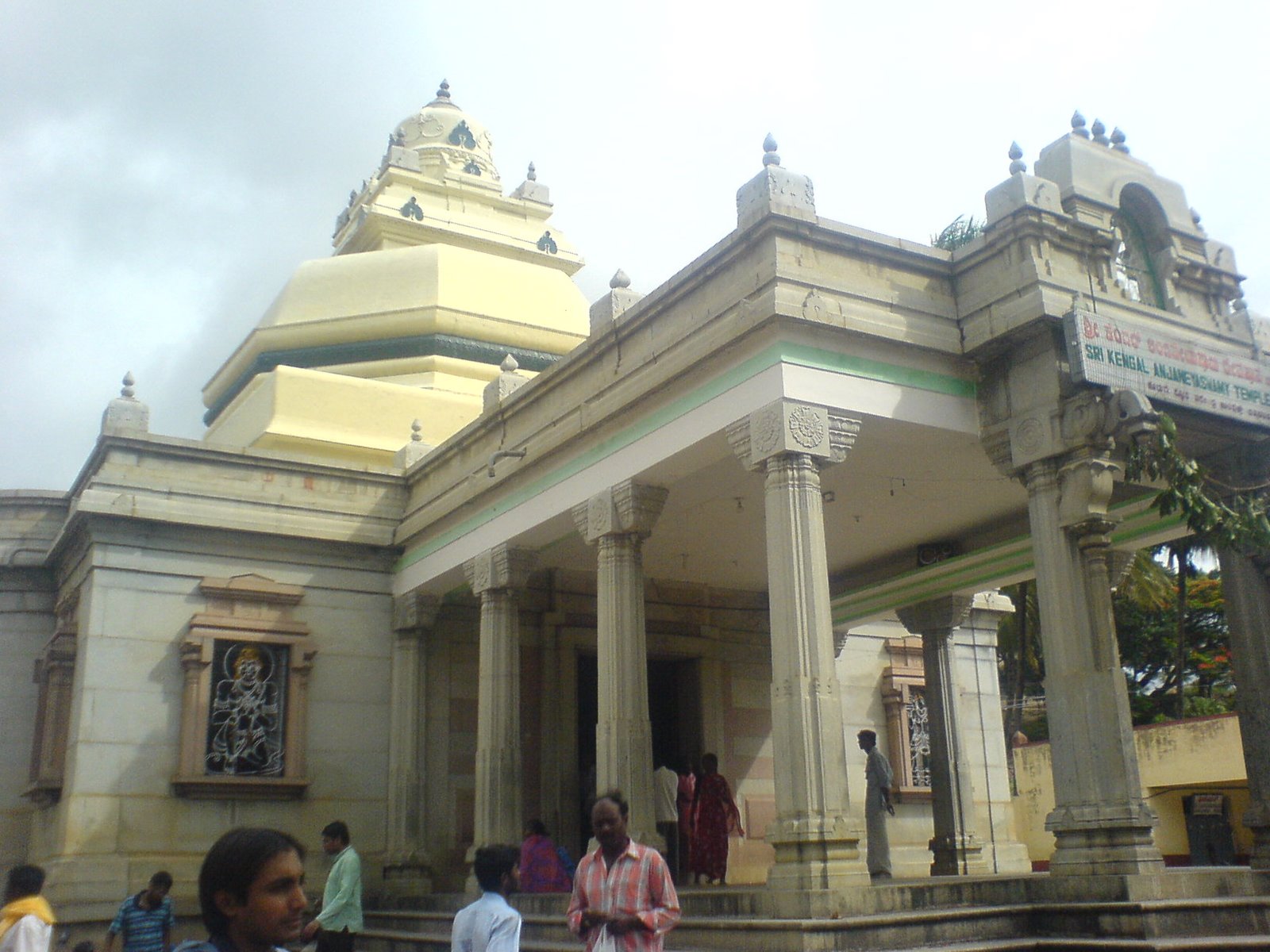
Kengal Anjeneya Swamy Temple, Chennapattana


The following temple is located in Vandaraguppe village,Channapatna dist, Karnataka. The presiding deity here is Swayambu Hanuman, which is a five & half feet long, and the idol sprouts a mustache.  It is very seldom for a ''swayumbu lord hanuman'' to sprout a mustache. Swayambhu (also spelled Svayambhu) means Self-manifested or that which is created by its own accord. Hanuman idol emerged from the red rocks, and to this date it is still emerging. ''Kengal'' in Kannada means 'redstone' from which the idol is emerging from, hence the lord is  called here as ''Kengal Hunumantha'' also know as Kengal Anjeneya Swamy'' It is to be noted that the idol is usually decorated with bright orange paint, called sindhoor. This idol is naturally bright orange-red!    


Few 1,000 years ago, Vyasa (sage) was passing by a bright red boulder. Upon discovering this, he was all excited and visualized an Hanuman etched from those rocks. The omni present lord Hanuman, full filled Vyasa's wish by slowly emerging from the rocks, with crisp details as vyasa imagined. This also included a very rare yet a perfect mustache. The temple was build by ''Hoysala kings''. After Hoysalas, no one cared to maintain the temple and as a result the temple almost reduced to rumble. A Karnataka Cheif Minister who goes by the same name as that of the lord, renovated the temple. He was building vidhansaudha, and used the same rocks and granites to renovate the temple. He was a staunch devotee of this Hanuman,  so he was buried closer to the temple. His Samadhi is at a stone throw's distance. Thanks to the ex CM, the temple is well maintained by the devotees and the temple trustees. the temple sees more devotees year after year! 


This temple, like any other ancient temples, is quite unique. Lord came here to please Vysa. The sage who wrote Hindu epic Mahabaratha. The idol is very powerful and vested with a lot of energy. Hence people with ill intentions cannot withstand the idol; it triggers vibes that can be harmful. The lord is merciless in punishing the mean & bad. The lord also does not fail to bless the good ones. Good and bad is not necessarily decided by our actions, but how much guilt we acquire from it. This is a famous hindu piligrimage site for childless couples and people with other illnesses.  


There are other fascinating phenomenon associated with this temple. This temple never ceases to surprise its devotees. Few decades ago, the idol's face was facing north, and over the years it now looks east! As the face moving from one direction to the other, the hidden eye is also evolving. When the idol was facing north, devotees could see only the right-side mustache and a right eye, now both the eyes are visible and so is complete mustache.    One of the architectural marvel of this temple is that, the first (sun) rays on Makara Shankranthi Day (jan 14/15) i.e the first day of Uttarayana falls directly on the idol. This does not happen on other days! 
Kengal Hanumanthaiah Temple ...


The difference between this temple and other temples is that prayers are answered on your first visit to the temple. Standing in front of this idol, absorbing powerful vibes, will make a commoner into a physic there by knowing the answer to the individual's prayers. It does not matter which part of the world you are in, nor the religion, praying to Hanuman in silence will make wonders!   


May lord Hanuman bless us all! 

Sunday, February 27, 2011

Virupaksha Temple, Mulabagalu

athama linga at the front and margadarshneshwara
linga behind. 
The Virupaksha temple is located in Virupakshapura Village in Mulbagal taluk of Kolar dst, Karnataka. This is a very special Lord Shiva Temple. In the sacred sanctum, there are two shiva lingas. One of them is an athma linga, called Virupaksha athma Linga. The specialty of this Linga is it changes its color thrice a day. This Athma Linga is blood red in color in the early mornings, in afternoons it is white, and in the evenings it takes honey color. This is one of very few Lingas that changes its color trice a day, one other being Kantheshwara (linga) temple in Mangalore.  No one can explain the color phenomena to this date. This still remains a mystery to the science community.  In the same sanctum, there is another Linga slightingly bigger than the Virupaksha athma linga called  ''Marga-Darsh-Neshwara Linga''. The story dates back to many 1000 centuries.  Atreya Muni did penance to lords shiva in front of Marga-Darsh-Neshwara Linga for many decades. Lord Shiva pleased by Artreya's devotion, showed up to him and handed the Virupaksha athma linga as token of appreciation. Athreya Muni, established the linga in the same sanctum. .

 It is believed that powerful radiations are emitted from the sacred sanctum. The point of origin of these radiation is the Athma Linga. The intensity of the radiations vary as per time of the day. High radiations are emitted early morning and in the evenings, i.e during sun rise and sun set. These radiations are very powerful. The radiations subdues and cancel out other negative radiations. There are special characteristics associated with these radiations. When exposed to these radiation, it is supposedly activates the right brain, which is all about arts and creativity. Besides honing ones creativity, these radiations also help children to improve memory power and also improves their I.Qs. Children affected by autism can be cured by exposing them to these rays, every day. These radiations can make a child agile, can help a mute child speak. There are many children in the vicinity of the temple who stand testimony. The school children are constantly made to expose to the rays, and as a result they have tremendously improved in the academics. In fact pupils from the near by schools made it a point to spend a lot of time in this temple, during school hours, as a result these children stands first in the state exams. These radiations can also cure chronic diseases like cancer, Tuberculosis, and other ailments which cannot be cured by the science are cured here. In fact the intensity of the radiation is so strong, that it will knock anyone who stands in its path. Anybody exposed to these rays for few minutes, one will start rocking back and forth. In the process one would not lose their balance and trip. People exposed to such rays has unique experience, for some it makes them feel light, for others it gives them adrenalin high. Each persons experience is as unique as their DNA structure. The radiation originates from the Athma Linga, and ends at the otherside of the temple called ''suruli'' 

In this temple complex, there is a sacred sanctum for Goddess Bagalamukhi, radiations from this idol can cancel out all the negative vibes caused by black magic and by other means. These rays can cure a lot of mental illnesses too. This temple was improvised by Krishna Devaraya. This temple is very unique and one of its kinds, it is one of those very few temples with very high active energy fields. Anyone can check it for themselves. Hence, this place is favorite for spiritual enlightment seekers.  Please add this temple to your must visit pilgrimage lists. 


Monday, February 14, 2011


The following temple is located in a lush green forest of kaannathur, kasargud dist in Kerala.  The temple is called Nalwaru, which litreally means 4 persons. However, the four persons at the temple are 'gods of ghosts'! The four deities are Ugramurthy, Panjurli, Raktha-Chamundi & Vishnumurthy. This temple is very sacred, and people fear the deities of the temple. The temple is filled with a lot of tantric powers, very typical to any Keralite temple.  The main purpose of this temple is that it servers as a people's court. Most of the disputes are settled in the temple courtyard, this has been the practice for many decades now. A plaintiff with truth on his side can give a petition to the temple authorities. And defendant will receive a memo (similar to a court's order) from the temple. If the defendant refuses to obey and decides not to respond to the orders from the temple, and decides not to show-up for hearing at the temple, such persons will be faced with sudden misfortunes, and sudden deaths in their family. Further more, It is also believed that such persons souls will be held by these 4 ghost gods. People in the region and in and around Mangalore, Karnataka are  very scared  of these 4 gods and do not even speak of these gods casually. Hence they normally show up to avoid the wrath of the ghost gods. It is to be noted that one of Mangalore's air crash victims soul was held by one such Ghost gods, and after a lot of begging and cajoling by the victim's family members the ghost gods released his soul, but did tell that all the victims soul from that crash is still held by them, they also confessed that it was not them that caused the accident, but a pilot's error. Mangalore Airport's runway was built after relocating a Ghost deity temple. This pilot's error was later confirmed by the investigation team.  The popular belief in this region is when a soul is held by a ghost god/s, the food prepared on their ''teethi'' is untouched by the crows or any other animals.

Although, they are not the typical temple we see elsewhere, they are indeed very powerful by all means and very sacred to this part of the country. No black magic will work in this temple, and anyone with ill intention cannot even enter the temple. They are ruthlessly punish the wrong doers. People from all faith worship these gods and frequently visit the temple to get swift justice and to find closure to their problems. It is strongly advised that anyone with no truth to his/her story should avoid giving petition to the temple, if they do they too will face the wrath! This temple is definitely one of its kinds-put this in your must see temple list!


Saturday, November 27, 2010

Sri Jagadguru Ajaatha Nagalinga Swamy Mutta-Navalagunda


Ajaatha Nagalingaswamy


The following temple is a testimony that the "Hinduism" is not a religion, but a way of life. This temple is UNIQUE and one of its kinds. The temple that I’m referring to is Sri Ajaatha Nagalinga Swamy Mata  in Navalagunda town in Darward Dist., Karnataka, India. Sri Ajaatha Nagalinga Swamy is a 19th century Yogi. He was born in Javalagi Village in Sindhanur town of Raichur Dist., Karnataka. He became a yogi at a very young age. He spent his initial life in wondering around, doing miracles, and helping people in distress.  He finally settled down at the Mouneshwara cave temple in Dharwad.  His teachings were very simple and anyone could easily understand and put it in to practice.  He preached; ''Ones heart is the temple while ones soul is the god''. So, one has to have a clean and pure heart. He believed in Advaitha philosophy. In his times he was very popular among villagers, still he is. He has many devotees and many followers.         

Ajaatha Nagalinga Swamy
He is a yogi who has uncanny resemblance to Jesus Christ. The Picture of Sri Ajaatha Nagalinga Swamy’s hung on the temple walls will concur with my comparison. When there is a mention of Jesus Christ then there should some reference to Bible. Yes, you read me right. There is indeed a very sacred book here and that is the BIBLE. Bible is the sacred book in this Hindu temple. Everyday, the temple priest offers prayers as per Hindu tradition and is kept for display. Every devotee who comes to this temple pays his/her prayers to the bible aswell. Bible written in Kannada-the official language of Karnataka state is not read in this temple. Although, bible is very sacred here it is not a ‘CHURCH’ but a ‘HINDU’ Temple.


Bible @ the sacred sanctum
The miracle of this temple is the bible, which is 
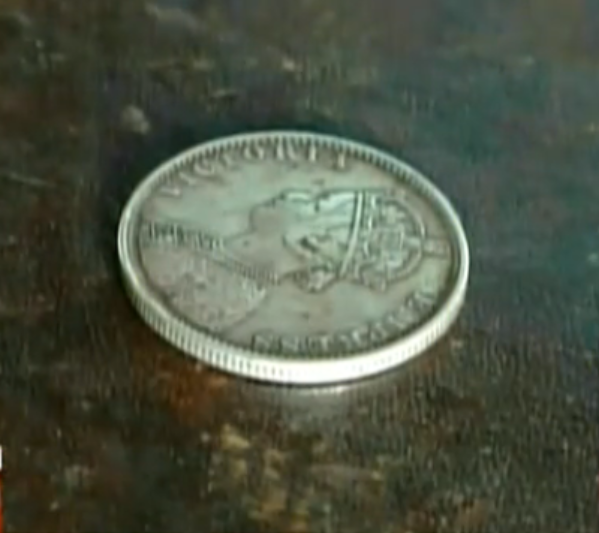
growing on its own. There is a very interesting story as how this Bible reached this temple. This Bible is one book and has both Old and New Testaments. Once lived a great Devi devotee by the name Kalappa in Mushteegeri village of Badami town in Bagalkote dist, Karnataka. Kalappa also showed interest in Bible reading; he had a first edition of bible (published in 1865 by Watson machine prints). Sri Ajaatha Nagalinga Swamy met Kalappa and prophesied his next birth. He took the bible from Kalappa, drilled a hole on it with the help of a hook (used to peel coconut from its shell).  The yogi then dropped a 1 Re Victorian silver coin in to the perforation. It came out from the other end smoothly. He informed Kalappa that the hole will completely close on its own and when it does, he will be born again in a different avatar.  From that day on, the hole started closing.. subsequently the missing words on the bible reappeared magically. As of today, the hole is a size of a needle. Yogi passed away in 1881. The yogi’s followers have erected the place where he is buried, a Shiva lingam. Late Kalappa gave away the Bible to the temple. To this date, the Bible and the Silver coin are preserved in this temple with great care and devotion.  And Temple officials have recorded the radius of this hole regularly. Anyone can access it, ofcourse with temple authorities permission. 


Bible and the coin

Thole that is closing on its own

The coin that was dropped inside the hole

initial measurement were recorded on the bible itself


Official records of the measurement
Besides bible, there are also some interesting items in this temple like the ‘Panja’ (The sword used during Muslim festival ‘Moharam’) and a “Cart” (sidagi in Kannada) used to carry the dead to the burial ground in this very same temple. No where else you will see bible, panja or the cart together in a hindu temple. This Sidagi was used as yogi’s chariot. Yogi used to sit on it and his followers carried him around. Yogi first found this abandoned cart at a graveyard, and requested his students to carry it while he sat on it. He requested to go around the village. Many villagers objected to this procession, as it is very uncommon for a living person to use a sidagi. Those who objected were mysteriously died, and  some  faced weird difficulties. They understood that yogi was not an ordinary person and then on they too became a staunch follower of the yogi. Thereby, yogi attracted many devotees from all walks of life. Today, female devotees tie green bangles in memory of yogi’s greatest devotee Beemavva to this cart for either for a prosperous marriage or for children. All their wishes have come true. Sometimes bangles are tied for various reasons too. Moharam too is celebrated in this Hindu temple. This temple resonates communal harmony from every nook and corner.


Panja

Sidagi


Although, yogi is not physically present, some devotees claim they have seen the yogi, while some others say they have heard the yogi speaking, either ways people in this region have great respect for the yogi, who has taught that making peace is more important than making war. This indeed will be one of my favorite Temple stories to this date. 


The arier view of the temple/mutt

The Entrence
The cave temple

The cave temple 1


Tuesday, November 16, 2010

Lakshmi Narasimha Swamy- Mangalagiri

The following Temple story has to be the most interesting stories so far. I am talking about Lakshmi Narasimha Swamy Temple in Mangalagiri. This place is 10kms from Vijayawada and is in Guntur District of Andra Pradesh. There are two Narasimha Swamy temples here. One on the Mangalagiri hills and the other at the bottom of the hill. The Lakshmi Narasimha Swamy temple on the hill is known as ‘Panaka’ Lakshmi Narasimha Swamy, while the temple at the bottom is known as Lakshmi Narasimha Swamy Temple. In Panaka Lakshmi Narasimha Swamy temple, there are no idols here. A Wall of a rock has an opening at the centre that resembles an open mouth is revered as Panaka Narasimha Swamy. The entire thing looks like a beautiful painting of Narasimha Swamy extended on the wall, keeping the opening as the mouth.

Panaka is a sweet drink, which is made out of sugarcane juice sugar & jaggery (sugar made out of sugarcane) different variations also exists. This drink is made on different occasions such as Ugadhi, Shivarathri, etc. The lord Narasimha Swamy here is popularly known as Panaka Swamy. He got this name ‘coz it is the favorite drink of this lord here. Panaka are offered to lord as ‘Naivaidhyam’ every single day. The specialty and the unbelievable thing here is whenever Panaka is offered to the lord and irrespective of the quantities offered, only equal half of the drink comes out from the other end, the other half is drunk by the lord himself. Also, one can here the gulping sounds as Panaka is pored it in to the openings through a conch. Only when the gulping sound is stopped, the remaining Panaka comes out from the other end. This Panaka is the ‘prasadam’ and is offered to the devotees. Ants, house flies and other flies are usually attracted to sweets and sweet drinks. However, there are no ants or flies in this temple in spite of spilling of huge quantities of Panaka, sugar and other ingredients on the Temple floor. Only when the world ends is when ants and flies are attracted to the sugar, this is the popular belief here.
  
                                   
Panaka
Managalagiri this place is one of the 8 important Mahakshetrams (sacred places) in India. The eight places where Lord Vishnu manifested himself are (1) Sri Rangam (2) Srimushnam (3) Naimisam (4) Pushkaram (5) Salagamdri (6) Thothadri (7) Narayanasramam (8) Venkatadri. Thothadri is the present Mangalagiri. Managalagiri is also known by several names such as stutadri, mukyadhi, and dharmadhi. Hasthadri, mangaladri. Vedavyasa has made references of this place in many puranas. Bhrmavartha Purana is one puranas that has references of this place. The lord here is worshipped from Krutha Yuga to till this date.

Enterance
The temple has a very interesting story to it. There was a demon by the name ‘Namuchi’ he tormented people of all lokas. So, Brahma-the creator of the universe along with the rest of the gods and goddess approached Maha Vishnu-the protector of the universe for a solution. Narasimha Swamy an incarnation of Vishnu attempted to kill the demon with his Sudarshana Chakra. However, the demon Namuchi escaped and took refuge at the MangalaGiri hills. He camouflaged as an insect and hid between the rocks by digging a hole on the ground to escape the ire of Narasimha Swamy. The witty lord realized this and closed the hole thereby suffocating the demon. The demon eventually died of lack of oxygen. The angry lord opened his mouth and got frozen as a rock. All the gods and goddess tried their best to subdue lord’s anger. Narasimha swamy instructed them to offer drinks thru’ this opening. From then on People and every one started poring drinks to the lord. Hence the practice of poring drinks in to the mouth came in to existence. It is believed that people offered Honey, Ghee, Milk and now Panaka in Sat Yuga, Treta Yuga, Dwapara Yuga and the current Kali Yuga, respectively.


The Temple down the hill is Lakshmi Narasimha Swamy. When Lakshmi was created while churning the milk ocean; gods and goddess built a pond here and brought water from all the holiest rivers all over. The Pond was later used by Mahalakshmi to bathe everyday. Goddess Lakshmi took bath, penance and meditated on Vishnu thereby sacrificing her life for Vishnu. Mahalakshmi in this temple is known as Rajalakshmi. All the rituals are carried out as per Vaishnava agamana shastra. Prayers are offered trice a day. On special days such as Narasimha Jayanthi, Vaikunta Ekadhasi, Rathsapthami, Ugadhi etc special poojas are offered.

Pond to correct an architecture errors

The Temples
Raja Vasireddy Venkatadri Naidu and Krishna Devaraya erected the temple towers.   Raja Vasireddy Venkatadri Naidu’s temple tower is 153 feet high and 49 feet in breath, has 11 floors and faces east and was built between 1807 and 1809.  The tower, built in just two years was slanting on the west side. To correct this error, after consulting with the architects and sculptors the king decided to dig a pond of 153 depth and of same breath as that of the tower in the east side to the tower. By doing so, the error was corrected. The pond became famous. The pond here is known as chekadu koneru (dark pond) Krishna Devaraya built front part of the temple. One can see the difference in the architecture. This temple is one of the fascinating temples in India. which have less width and more height like this tower. Utthara Gali Gopuram (Tower on North Side) is opened on the Vaikunta Ekadasi (Mukkoti) day. It was constructed by Rangapuram Jamindar Madapati Venkateswararao in 1911. When Padamati Gali Gopuram (Tower on West Side) was being constructed, accidentally some stones fell down and some workers died. By this incident, the work was stopped and had not been started till now. Dhakshina Gali Gopuram (Tower on South Side) was renovated in 1992 for Krishna pushkaras by the initiative of the Executive officer Sri Nootakki Kotaiah.

Temple Towers